





Understanding the 2026 Fair Access to Banking Laws
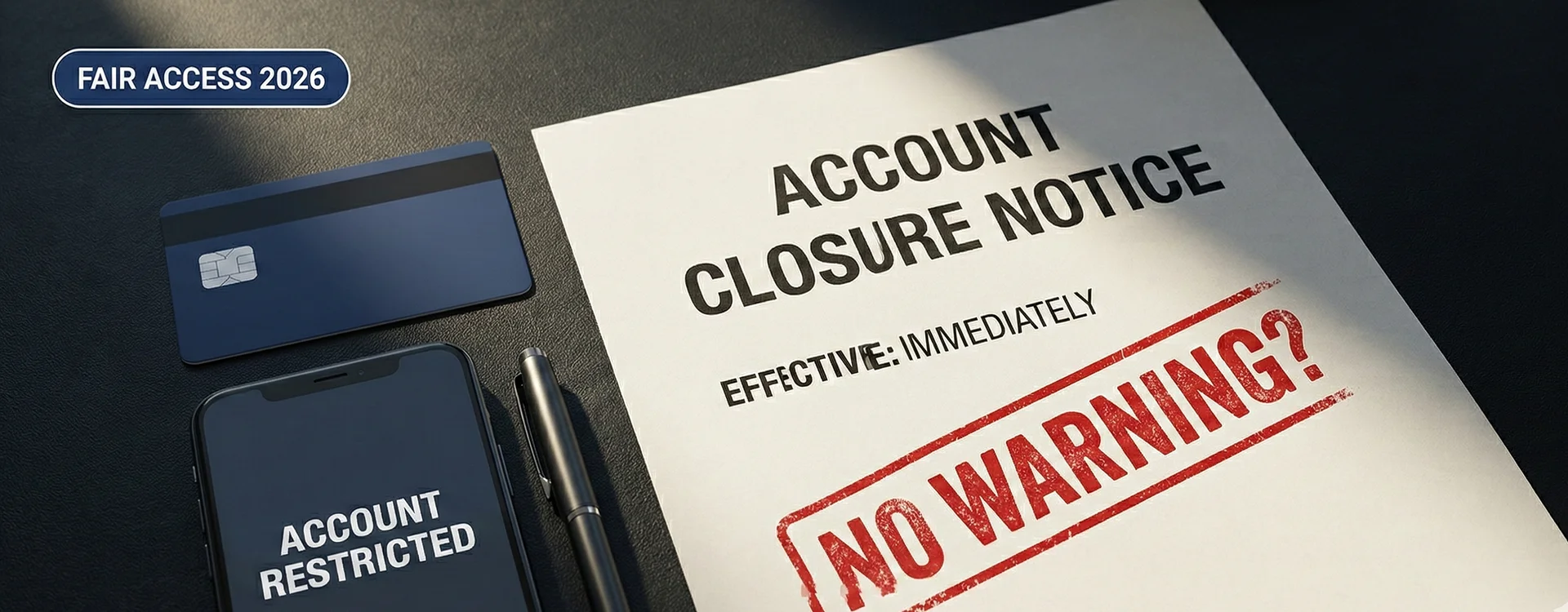
The 2026 Fair Access to Banking Laws aim to address the concerns over sudden closures of bank accounts. These federal and state-level measures aim to ensure that individuals and businesses are denied access to basic banking services for reasons that are unrelated to financial risk and compliance. The laws focus on transparency, risk-based decision-making, and consistency in the ways accounts are terminated. It still focuses on fraud prevention and regulatory compliance.
What the new federal regulations mean
At the federal level, the new fair access framework builds a set of actions that discourage banks from closing accounts for subjective and non-financial reasons. It focuses on the principle that banking decisions should be based on objective rules, such as financial, fraud risk, or compliance with anti-money laundering reasons
The key requirement is to encourage the regulators to clarify the ambiguities, review supervisory guidance and clarify the risk-based standards which may lead banks to unnecessary account closures. These rules do not eliminate a bank’s rights to end relations with a customer. The aim is to promote clear internal policies and better documentation of decisions. Banks are expected to justify account closure by measurable factors
State-level adaptations
- Apart from federal actions, several states have also introduced their own fair access rules customized to local regulatory conditions. Florida ‘s fair access to financial services restricts the financial institutions from denying or closing services for non financial or subjective reasons. The law promotes the idea that decisions should be based on a lawful business activity. It also allows accountability by reviewing bank practices within the state.
- Tennessee’s Debt Resolutions Services Act also seeks to protect the lawful businesses from the denial of financial services without clear reasons. However, the scope of these rules varies by state; it collectively signals the accountability of how and why banks restrict services.
Why these laws matter for consumers and businesses
The laws are of great significance for consumers and especially small businesses. Restricting or closure of bank service can disrupt the daily operations, payments, payroll and credit with little warning. Sudden closure of financial services can be damaging for small businesses that rely on these services 24/7. Overall, the 2026 framework aims to reduce uncertainty by promoting transparent banking services.
The laws also intersect with reputational risks and ESG(Environment, Social, Governance) factors in banking. The data suggest that in recent years, account closure reasons were based on reputational risk rather than financial risk. 2026 fair banking rules focus on this approach that banking decisions should not overly rely on ESG scoring or subjective reasons. While banks still have their rights,the shift is towards fairness,transparency, and accountability in financial services.
Can Banks Still Close Accounts Without Warning?
Banks have broad rights to close a customer’s account, but there are some important limits and restrictions worth understanding. These decisions are supposed to be governed by scrutiny, agreements, and regulations.
Exceptions under the law
There are some scenarios where account closures are permitted and justified.
- Banks are responsible for protecting their customers and the financial system. If an account is found to be involved in fraudulent activity, identity theft, or unauthorized transactions, the bank has the authority to close that account and freeze the funds.
- According to federal law, the bank is responsible for complying with the sanctions program. If an account is found to launder money, finance terrorism, or violate the sanctions programs, the bank is legally allowed to close that account.
- If a customer repeatedly violates the banking laws or provides false information,the bank has a legal right to close the account.
These exceptions are clear and show that banks uphold financial integrity and comply with federal law.
Operation Choke Point and historical context
In the early 2010s, Operation Choke Point became the topic of discussion about the sudden closure of bank accounts. The Justice Department encouraged banks to scrutinise the high-risk industries. Some banks responded by unilaterally terminating the accounts of legal businesses just out of regulatory security and compliance burden. The operation ended in 2017, but its results influenced how banks approach risk, leading to a zero-tolerance policy.
The historical context explains the reason behind some unexpected account closures. Risk models, compliance pressure, and reputation concerns play a vital role in banking decisions.
Secondary Impacts on Businesses and Individuals
The 2026 fair access to banking laws do not just protect customers, but they also have impacts on businesses and banks. Understanding these impacts can help business organisations understand the risk and stay compliant.
SBA lender notices and risk management
Banks and SBA-approved institutions must check their monitoring process under the new regulations. Businesses now may receive frequent notices regarding flagged transactions, compliance review, and account changes. Risk management strategies need to be balanced with laws and regulation with the continuous operations. So that accounts are not closed abruptly.
Reputational and ESG risks
Account closure can impact the reputation of the business and ESG score. Banks, while taking operational decisions, evaluate ESG scoring. Businesses with a bad reputation and suspicious activities will face indirect consequences. These consequences include bad public perception, scrutiny, and reduced financing options.
How the Trump executive order on debanking intersects with the 2026 laws
President Trump issued an executive order “Guaranteeing Fair Banking For All Americans” on August 7 2025. It directs bank regulators to remove the reputation risk factors while examining banks.
The fair access to banking laws have now restricted these arbitrary account closures, demanding clear notices and justifications. Businesses that were affected as a result of prior debanking practices may now seek protection. Federal policy shift pushes regulators to eliminate subjective factors while examining accounts.
State-specific considerations
Florida Fair Access laws focus on consumer protection but also provide guidance to banks for risk management. Businesses and financial institutions in Florida must align their practices with federal and state laws to prevent sudden account restrictions.
The Tennessee Debt Resolution Act emphasizes transparency and fairness in account handling and debt management. Businesses are obliged to ensure that their accounts monitoring, closure and reporting procedures comply with federal fair access provision and state laws.
Steps to Protect Your Accounts in 2026
With the 2026 fair access to banking laws in place, businesses, banks, and financial institutions can do the following practices to stay proactive and compliant.
Best practices for businesses and consumers
One of the best practices that businesses and consumers can do is to diversify their banking relationships. Consider diversifying your accounts by using these 10 vendor accounts that help build business credit fast. Do not rely on one bank for all your financial services. It will reduce the impact of account closure.
Regularly check that your bank account complies with AML and other regulatory obligations. Address the notices and alerts immediately. Maintain an updated documentation for operations and compliance audits.
Working with lenders and state regulators
Stay connected with SBA lenders, commercial banks, and regulatory bodies. Submitting the timely reports, understanding requirements, and clarifying a flagged activity can prevent a misunderstanding.
Legal remedies and advocacy
Under the new 2026 fair access to banking laws, if accounts get closed without prior notice, you can take legal recourse.
- Requesting a legal explanation.
- Filing a complaint with state bank regulators.
- Taking legal help under federal and state laws.
- Supporting systematic change by engaging advocacy groups.
Conclusion
The new 2026 Fair Access to Banking Laws protect businesses and consumers against sudden account closure. These laws set rules for transparency, accountability, and prior notifications to ensure that banks can not terminate accounts without legitimate reasons.
While these laws give protection against unfair banking practices, businesses and individuals should also stay vigilant. They should regularly check account activities, compliance with rules, and essential steps to safeguard themselves. Stay informed about state and federal regulation updates. By staying informed and proactive, you can perfectly navigate the evolving financial landscape.