






If you are stuck choosing between a small business grant and a loan, you are not alone. Most business owners hit this exact roadblock the moment they start looking for money to grow. Both options sound promising, but they work in completely different ways. Picking the wrong one can slow you down or cost you money you didn’t need to spend.
It is essential to understand small business grants vs loans. It helps you avoid the stress and make smarter funding decisions. This guide breaks down how each option works, who qualifies, repayment rules, real pros and cons, and how to decide which one actually fits your goals.
What Is the Difference Between a Grant and a Loan?
When people compare business grants vs business loans, the first thing they want to know is this: What makes them so different? To put it simply, a grant is money awarded to your business with no expectation of repayment. Ever wondered what is a small business grant? Think of it as funding meant to support specific types of companies or projects, usually tied to innovation, community development, or underrepresented founders.
A loan is the opposite. Even with options like forgivable small business loans, repayment is expected unless you meet strict conditions. This is why the difference between a grant and a loan for small business matters so much: one adds zero debt, while the other becomes a monthly obligation.
Many owners also ask, “Do you have to pay back small business grants?” Generally, no, unless you misuse the funds or break the program rules. It is important to understand this distinction because repayment affects your cash flow, stress levels, and how you plan your next stage of growth.
This quick table shows how they differ and when each one actually makes sense, especially for founders exploring grants vs loans for startup funding.
| Feature | Grants | Loans |
| Repayment | Not required (if rules are followed) | Required, fixed schedule |
| Eligibility | Harder to qualify | More flexible |
| Speed | Slow approval | Fast approval |
| Funding Amount | Low to medium | Medium to high |
| Best For | Startups, community projects, R&D | Growing and established businesses |
What We Commonly See
Many business owners spend months applying for grants when a loan would solve the problem faster. We also see the opposite: businesses taking on debt for projects that may have been a better fit for grant funding.
The key is not deciding whether grants or loans are “better.” The key is matching the funding source to the business’s timeline, cash flow, eligibility, and growth goals.
A Closer Look at Small Business Grants

Small business grants attract so much interest because they remove the fear of debt. These programs, especially government grants for small business start-ups, are created to support founders who need funding but may not qualify for traditional financing. Grants fall under non-repayable small business funding, meaning you keep the money as long as you follow the rules and complete the intended project.
Here’s what business owners should know:
You don’t Repay Grants
Most founders ask, “Do you have to pay back small business grants?” The answer is no, unless you misuse funds or fail to meet program requirements.
Where Grants Come From
Funding may come from federal agencies, state economic programs, private foundations, or corporations offering the best grants for small business owners in specific industries or communities.
Why Grants are Competitive
Many apply, few qualify. Grant providers look for mission alignment, impact, and clear business goals.
How to Find Legitimate Grant Opportunities
Search verified government databases, local development centers, and curated lists that specialize in how to find small business grants without scams.
Eligibility Rules Matter
Each program has strict small business grant eligibility requirements, including industry, size, ownership type, or the purpose of your project.
When comparing small business grants vs loans, grants win on cost but require patience, detailed applications, and a strong strategic fit.
Why Many Owners Choose Business Loans?
For many entrepreneurs, loans end up being the more realistic and strategic path. It is not because grants are unappealing, but because they rarely move at the speed a business needs. In the world of business funding options: grants and loans, grants reward patience, while loans reward momentum. This is exactly why so many owners lean toward financing instead of waiting months for an uncertain response from a grant program.
Here’s what makes loans the preferred choice for countless business owners:
Fast access to capital
When opportunities appear, new equipment, a contract, an expansion, you often can’t wait. Bank loans, SBA loans, and especially online lenders can fund you in days, sometimes hours. Grants simply can’t match that speed.
Higher funding limits
Grants tend to offer smaller awards. Loans allow you to secure the significant capital needed to scale, hire, or cover high operational costs.
Clear repayment structure
Many owners appreciate the predictability. Monthly payments create a rhythm and help you map out long-term cash flow with fewer surprises.
Even forgivable small business loans begin as loans, but they offer a unique middle ground for businesses that qualify.
Most importantly, loans make sense when hesitation costs you more than interest ever could. If your revenue is stable and timing matters, loans provide the flexibility that grants simply cannot.
For a deeper look into how lenders evaluate applications, visit the Small Business Loan Approval guide.
When to Choose a Grant vs a Loan
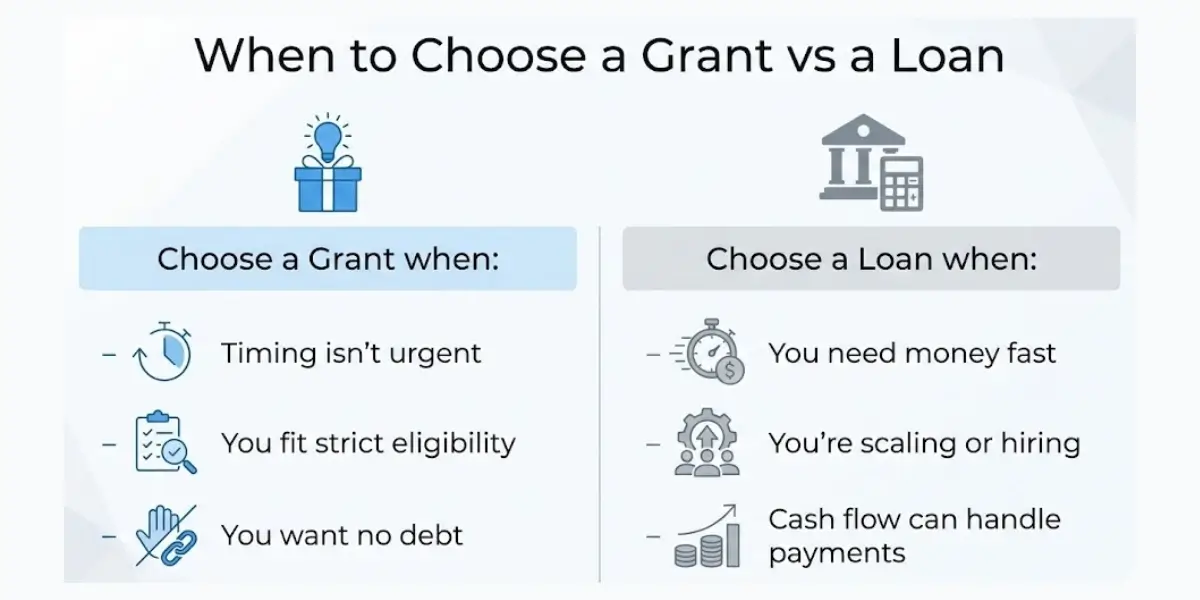
Business owners often ask, “Should I apply for a grant or a loan?” The answer depends entirely on your timing, your cash flow, and the kind of opportunity you’re pursuing. Understanding when to use a grant vs a loan can save you from wasted applications and missed opportunities.
A Grant is Ideal When
- You are launching a startup, research project, or community-focused initiative
- Your funding needs are not urgent
- You match a specific eligibility category
- You prefer small business grants vs loans to avoid taking on debt
A Loan is Ideal When
- You need money quickly
- You are scaling, hiring, or buying equipment
- Cash flow is strong enough to handle repayment
- You need predictable, long-term working capital
Ready to move forward with a loan? Read How to Get Approved for Small Business Loans in 2025.
The choice ultimately comes down to urgency, repayment ability, and alignment with program criteria. Grants reward patience; loans reward readiness.
A Real-World Observation
A service business we reviewed needed capital to hire staff and expand operations. The owner initially pursued grants, but most programs had long timelines or strict eligibility requirements.
Because the business already had stable revenue and predictable cash flow, financing became the more practical option.
In another situation, a startup focused on a community-based project had more time and aligned closely with grant objectives, making grant funding a better path.
Certain details have been modified to protect privacy.
Pros and Cons: Small Business Grants vs Loans
Understanding the small business loan vs grant pros and cons helps you avoid costly mistakes.
Grants
| Pros | Cons |
| No repayment | Extremely competitive |
| No interest | Slow approval times |
| Great for startups or mission-driven projects | Strict eligibility requirements |
Loans
| Pros | Cons |
| Fast funding | Requires repayment |
| Higher amounts available | Interest and fees |
| Flexible use cases | Financial risk if cash flow is unstable |
There is no better option. Choose one that fits your business’s current reality.
Conclusion
Choosing between a grant and a loan becomes much easier once you understand what each one offers and what they expect in return. Let your funding goals, timing, and cash flow guide your decision. Choose the option that moves your business forward, not the one that holds you waiting.
Your next step could open the door to the strongest growth your business has ever seen.