




What is the SBA Loan Fee Waiver 2026?
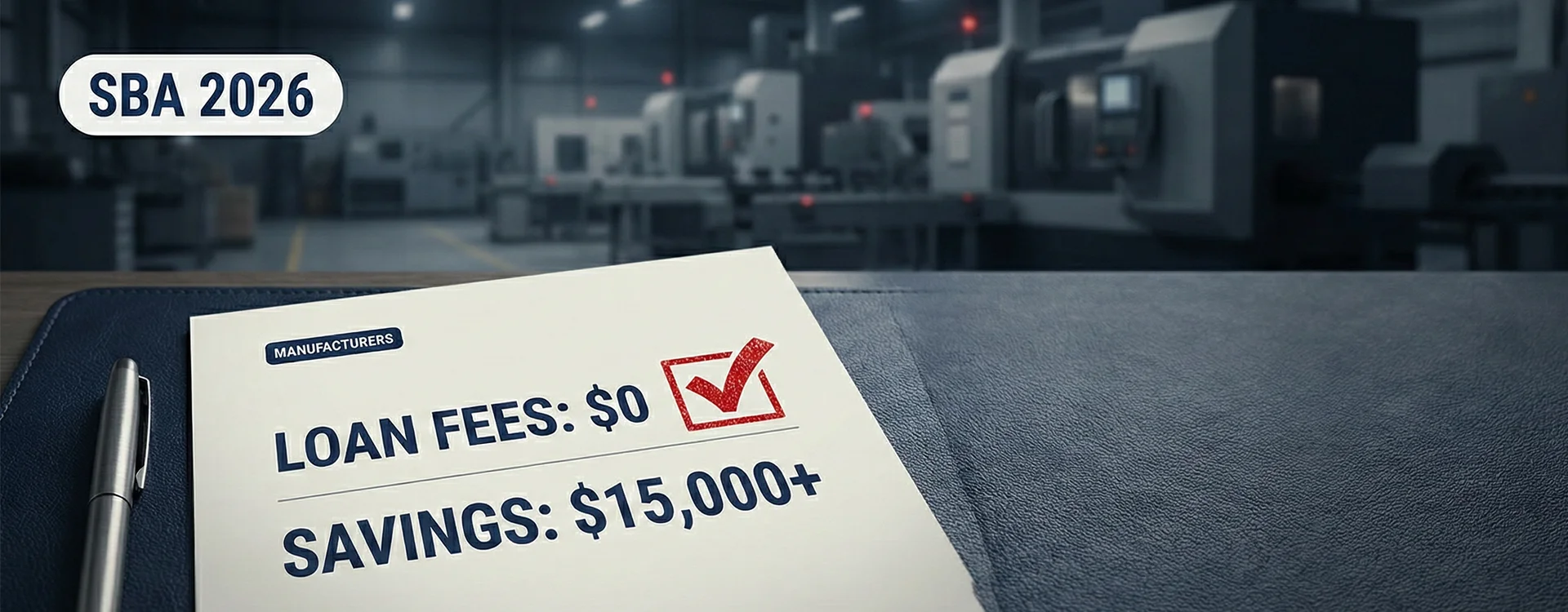
For fiscal year 2026, the U.S. Small Business Administration has temporarily removed key loan fees for qualifying manufacturers. The SBA loan fee waiver 2026 applies to loans approved between October 1, 2025, and September 30, 2026, making SBA financing far more affordable during this period. According to the U.S. Small Business Administration, this fee relief applies to qualifying manufacturing businesses under SBA-backed loan programs during fiscal year 2026.
Historically, securing an SBA loan meant paying a significant upfront guaranty fee, a cost the SBA charges to back your loan. While this fee helps the program remain self-sustaining, it often siphons off tens of thousands of dollars from a manufacturer’s working capital right at the moment they need it most.
With the SBA loan fee waiver 2026, that burden is being lifted to encourage a “Made in America” resurgence.
Why Now? The Made in America Manufacturing Initiative
This move isn’t just a random policy change; it is the cornerstone of the Made in America Manufacturing Initiative. The federal government has recognized that 98% of U.S. manufacturers are small businesses.
To strengthen domestic production and reduce reliance on overseas supply chains, manufacturers need easier access to capital. The SBA loan fee waiver 2026 lowers borrowing costs so businesses can invest in equipment, facilities, and workforce growth without losing cash to upfront fees.
Are You Eligible? Decoding NAICS 31-33 SBA Loans
To take advantage of the SBA loan fee waiver 2026, your business must fall under specific industry classifications. The SBA uses the North American Industry Classification System (NAICS) to determine eligibility. Specifically, this waiver is laser-focused on NAICS 31-33 SBA loans.
What falls under NAICS 31-33?
If your business transforms raw materials or components into new products, you likely qualify. Common eligible sectors include:
- NAICS 31: Food, tobacco, textiles, and apparel manufacturing.
- NAICS 32: Wood products, paper, printing, petroleum, chemicals, plastics, and rubber.
- NAICS 33: Metal fabrication, machinery, computer and electronic products, electrical equipment, and transportation equipment.
By targeting these sectors, the SBA loan fee waiver 2026 ensures that the “engine room” of the American economy, the people actually making physical goods, receives the most support.
SBA 7(a) Manufacturer Incentives: Saving on Working Capital
The 7(a) loan program is the SBA’s most popular offering because of its flexibility. You can use it for anything from inventory to debt refinancing. For 2026, the SBA 7(a) manufacturer incentives have made this program even more attractive.
The $950,000 Sweet Spot
For any 7(a) loan of $950,000 or less made to a qualifying manufacturer, the upfront guaranty fee is reduced to 0%. Under normal circumstances, a $950,000 loan would require an upfront payment of roughly $21,000 to $25,000. Under the SBA loan fee waiver 2026, that money stays in your bank account.
How Much Can You Save?
| Loan Amount | Standard Upfront Fee (Est.) | 2026 Manufacturer Fee | Total Savings |
| $350,000 | $7,875 | $0 | $7,875 |
| $500,000 | $11,250 | $0 | $11,250 |
| $750,000 | $16,875 | $0 | $16,875 |
| $950,000 | $24,937 | $0 | $24,937 |
These savings can have a real impact on day-to-day operations. For many small manufacturers, keeping an extra $15,000 to $25,000 in cash can support hiring, equipment upgrades, or added production capacity.
The 504 Advantage: No Annual Service Fee for Heavy Industry
While the 7(a) program is great for general needs, the 504 loan program is designed for “big ticket” items like real estate and long-term machinery. The SBA loan fee waiver 2026 provides even deeper benefits here.
In the 504 program, the SBA has waived both the upfront guaranty fee and the annual service fee for manufacturers. This is a game-changer because the annual service fee is an ongoing cost calculated against the outstanding balance of your loan. By removing it, the SBA is effectively lowering your interest rate for the life of the loan.
Why 504 Loans are Better for Manufacturers in 2026
- Fixed Rates: You lock in a low interest rate for 10, 20, or 25 years.
- Low Down Payments: Usually only 10% is required, preserving your cash.
- Zero SBA Fees: Thanks to the SBA loan fee waiver 2026, the “friction” of government lending is gone.
If you are planning to build a new warehouse or install a multi-million dollar robotics line, the 504 program combined with the SBA loan fee waiver 2026 is likely your most cost-effective path.
Introducing the SBA MARC Loan Program
In tandem with the fee waivers, the SBA has launched a brand-new tool: the SBA MARC loan program. MARC stands for “Manufacturers’ Access to Revolving Credit.”
A Revolving Line of Credit Tailored for You
Unlike traditional term loans where you get a lump sum and pay it back, the MARC program offers a revolving line of credit. This is crucial for manufacturers who deal with “lumpy” cash flow, spending a lot on raw materials upfront and waiting months for customers to pay invoices.
The MARC program allows you to:
- Access up to $5 million in credit.
- Draw down funds only when you need them.
- Pay interest only on the amount you’ve actually used.
While the SBA loan fee waiver 2026 applies to standard 7(a) and 504 term loans, the MARC program focuses on flexible access to capital through a revolving line of credit for day-to-day manufacturing needs.
Real-World Impact: How the Waiver Changes Your Math
Let’s look at a hypothetical example. Imagine you own “Precision Parts Inc.,” a small metal fabrication shop (NAICS 33). You need a $800,000 loan to buy two new laser cutting machines and hire three operators.
In 2024, your upfront guaranty fee would have been approximately $18,000. You likely would have rolled that fee into the loan, meaning you’d be paying interest on that $18,000 for the next ten years.
In 2026, with the SBA loan fee waiver 2026, that $18,000 fee is gone.
- Immediate Saving: $18,000.
- Interest Saving: Roughly $5,000 over the life of the loan.
- Total Benefit: $23,000.
That is money you can use for your down payment, or better yet, as a safety net for your first year of expansion. The SBA loan fee waiver 2026 is essentially a “welcome home” gift for American manufacturing.
How to Apply and Secure Your Savings
Because the SBA loan fee waiver 2026 is a one-year initiative (expiring September 30, 2026), timing is everything. You don’t want to wait until August to start your application, as the surge in demand from other manufacturers could slow down processing times.
Step 1: Confirm Your NAICS Code
Check your latest tax return. Look for the “Business Activity Code.” If it starts with 31, 32, or 33, you are in the door for the SBA loan fee waiver 2026.
Before moving forward, it helps to review the basic approval requirements. This guide on how to get approved for small business loans in 2025 explains what lenders look for before you apply for the waiver.
Step 2: Choose Your Loan Type
- Need cash for payroll and materials? Look at the SBA MARC loan program.
- Buying a new building? Go with the 504 loan.
- General expansion? The 7(a) program is your best bet.
Step 3: Prepare Your Paperwork
Lenders will still want to see that you are a “good bet.” You will need:
- Three years of business and personal tax returns.
- A detailed business plan explaining how the expansion will increase production.
- A debt schedule and current financial statements.
Remember, the SBA loan fee waiver 2026 makes the loan cheaper, but it doesn’t make it “automatic.” You still need to demonstrate a clear ability to repay the debt.
Maximizing the “Made in America” Opportunity
Beyond just the SBA loan fee waiver 2026, the current economic climate is shifting in favor of domestic production. The federal government is increasingly prioritizing “Made in America” products for government contracts. By using the SBA loan fee waiver 2026 to upgrade your facility now, you position your business to win those lucrative contracts in the future.
Modernizing your shop with automated systems or energy-efficient machinery not only saves you money on labor and utilities but also makes your business more resilient. The SBA loan fee waiver 2026 is the bridge that helps you get from “surviving” to “scaling.”
Conclusion
The SBA loan fee waiver 2026 removes some of the most expensive barriers to SBA financing for manufacturers. By eliminating upfront guaranty fees on 7(a) loans and annual service fees on 504 loans, the program allows more of your capital to stay focused on growth.
Whether you are expanding production, upgrading equipment, or purchasing property, applying before September 30, 2026, can result in meaningful long-term savings.